
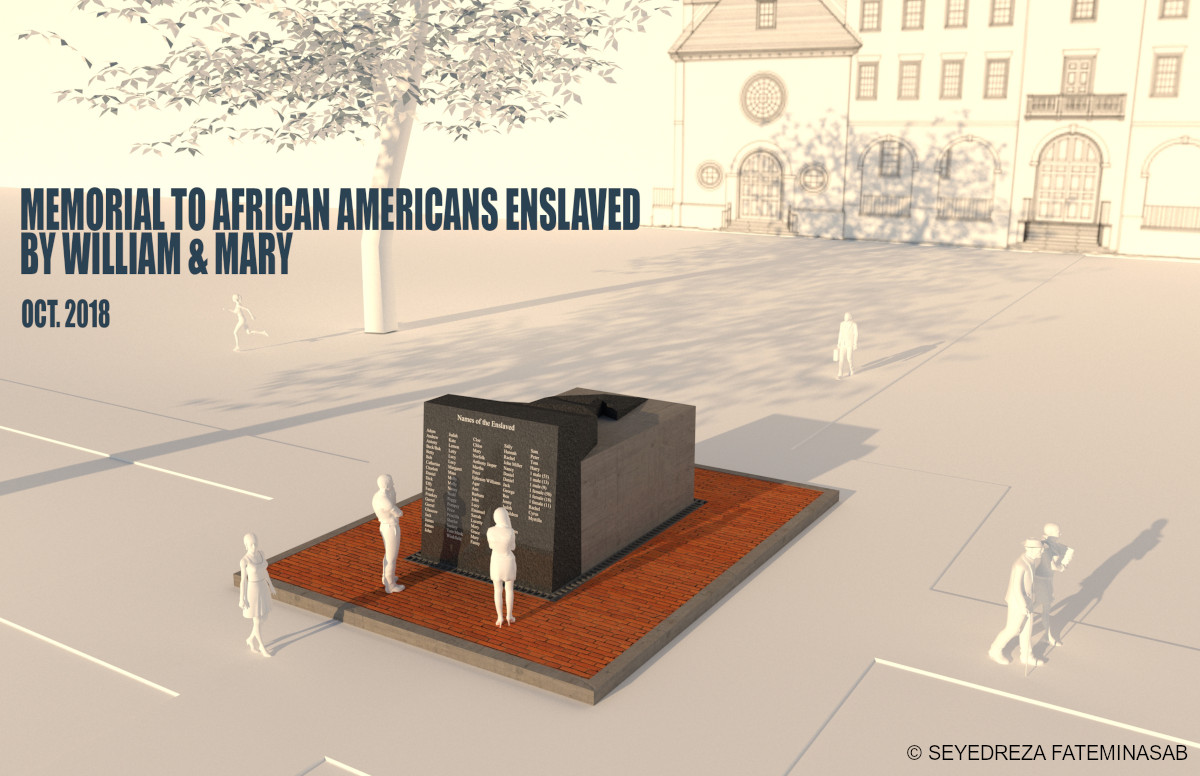
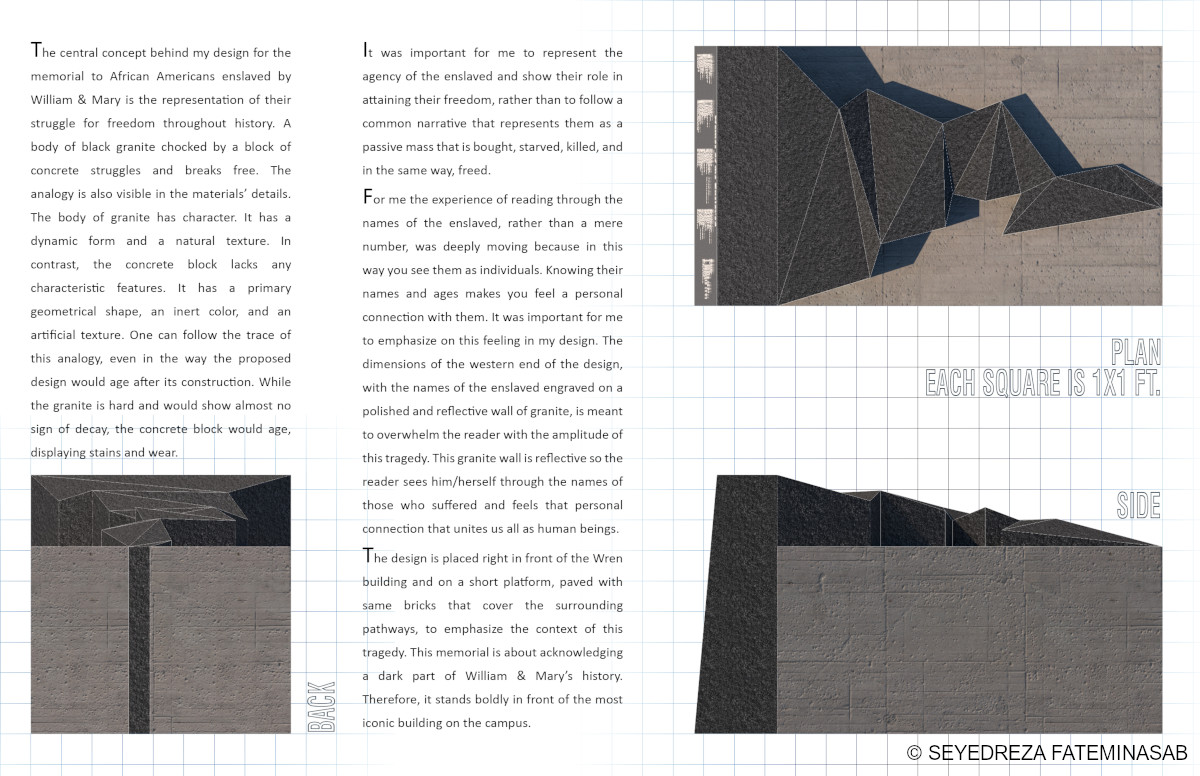
The central concept behind my design for the memorial to African Americans enslaved by William & Mary is the representation of their struggle for freedom throughout history. A body of black granite chocked by a block of concrete struggles and breaks free. The analogy is also visible in the materials’ details. The body of granite has character. It has a dynamic form and a natural texture. In contrast, the concrete block lacks any characteristic features. It has a primary geometrical shape, an inert color, and an artificial texture. One can follow the trace of this analogy, even in the way the proposed design would age after its construction. While the granite is hard and would show almost no sign of decay, the concrete block would age, displaying stains and wear.
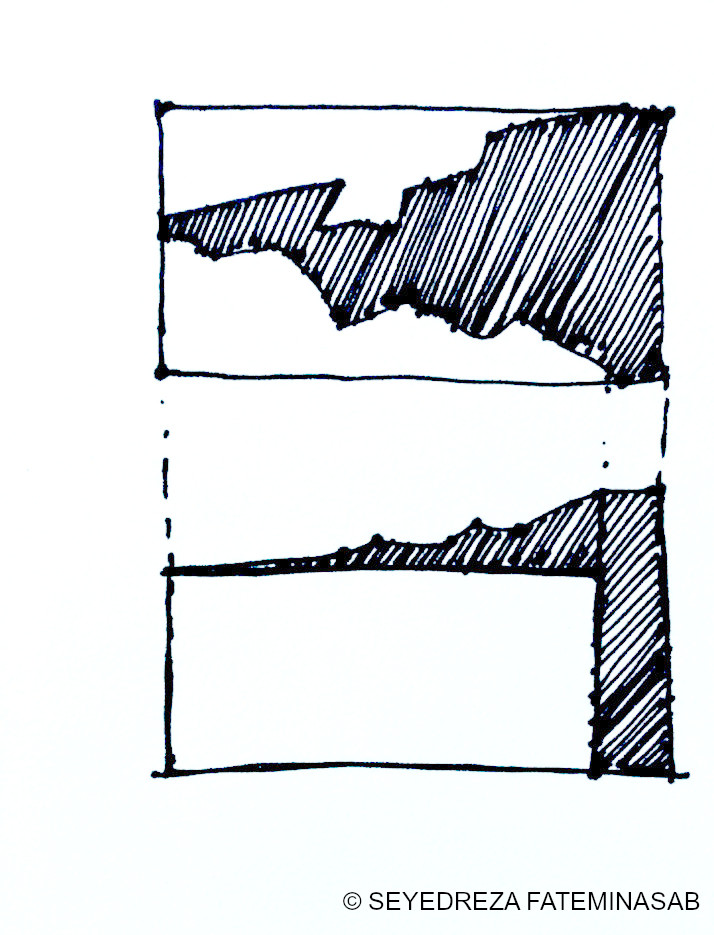
It was important for me to represent the agency of the enslaved and show their role in attaining their freedom, rather than to follow a common narrative that represents them as a passive mass that is bought, starved, killed, and in the same way, freed.

Cover
Description
Site
Elevation
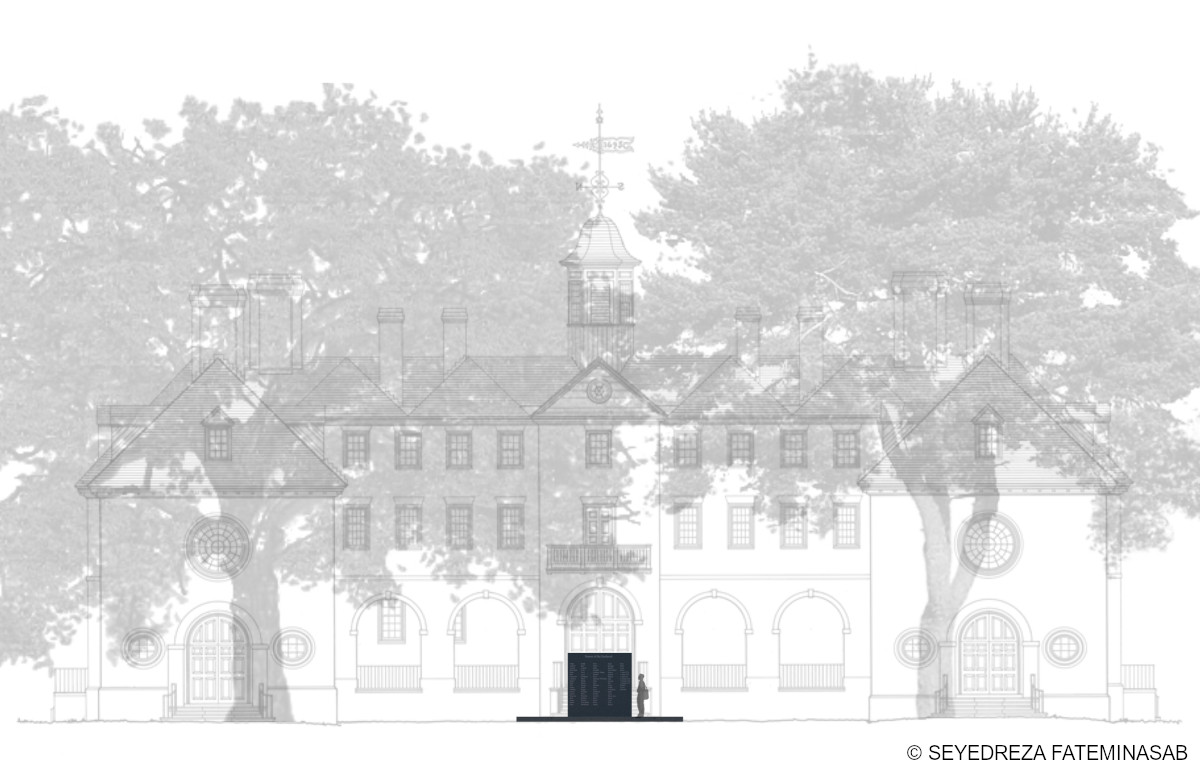
For me the experience of reading through the names of the enslaved, rather than a mere number, was deeply moving because in this way you see them as individuals. Know their names and ages makes you feel a personal connection with them. It was important for me to emphasize on this feeling in my design. The dimensions of the western end of the design, with the names of the enslaved engraved on a polished and reflective wall of granite, is meant to overwhelm the reader with the amplitude of this tragedy. This granite wall is reflective so the reader sees him/herself through the names of those who suffered and feels that personal connection that unites us all as human beings.
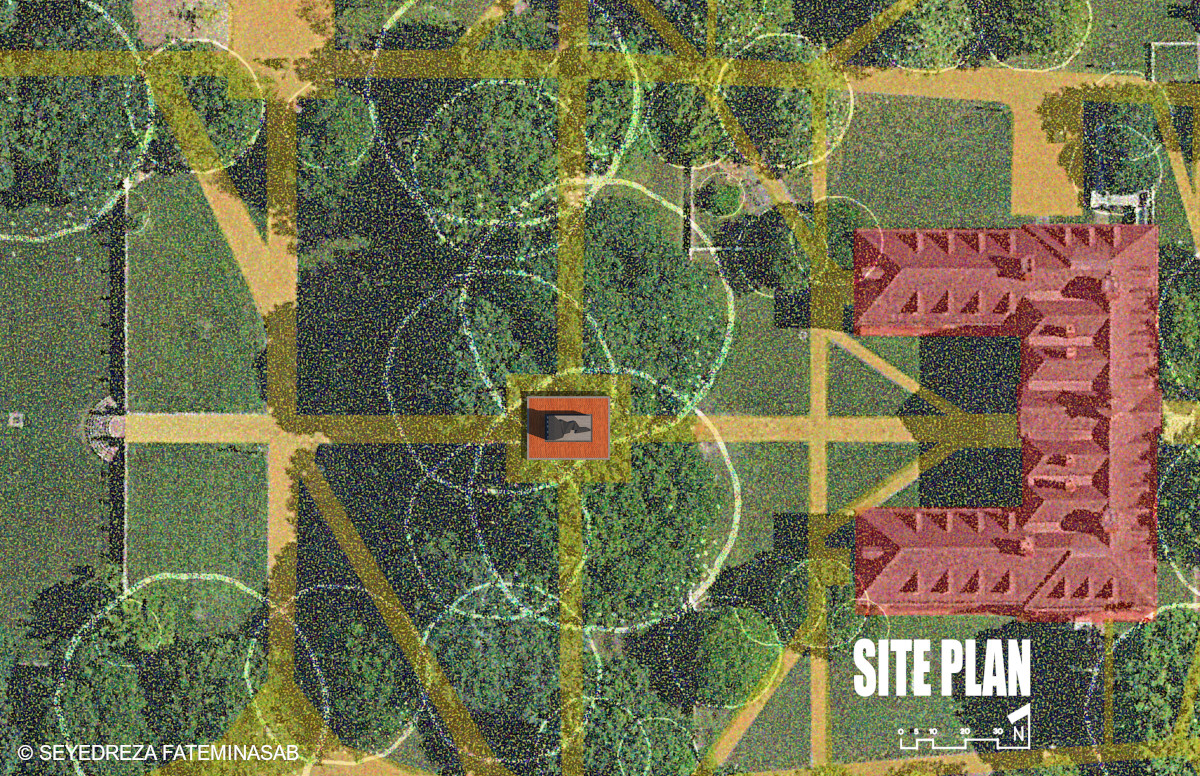
The design is placed right in front of the Wren building and on a short platform, paved with same bricks that cover the surrounding pathways, to emphasize the context of this tragedy. This memorial is about acknowledging a dark part of William & Mary’s history. Therefore, it stands boldly in front of the most iconic building on the campus.